Hello! Welcome to visitShanghai Bosen Environmental Technology Co., LtdOfficial website!
Specialized for electronic and semiconductor cleaning applications · Complies with the American Electronic Grade 1 Water Standard (ASTM D5127 E-1.1 / SEMI F63 Grade 1)
Water output: 15 tons per hour (15,000 L/h)
Water resistivity: 18.25 MΩ·cm (25°C)
This equipment is a 15 T/H EDI ultrapure water generation system with a rated output capacity of 15 tons per hour (15,000 L/h). The produced water's electrical resistivity consistently reaches 18.25 MΩ·cm (at 25°C), approaching the theoretical limit for pure water. The system employs a comprehensive treatment process comprising "pre-treatment + dual-stage RO + EDI + polishing mixed bed + dual-wavelength UV + UF ultrafiltration + circulating distribution," ensuring that the output water fully complies with the American Electronic Grade 1 Water Standard (ASTM D5127 E-1.1 / SEMI F63 Grade 1). It is specifically designed for applications requiring exceptionally high water quality, such as electronic and semiconductor cleaning processes.
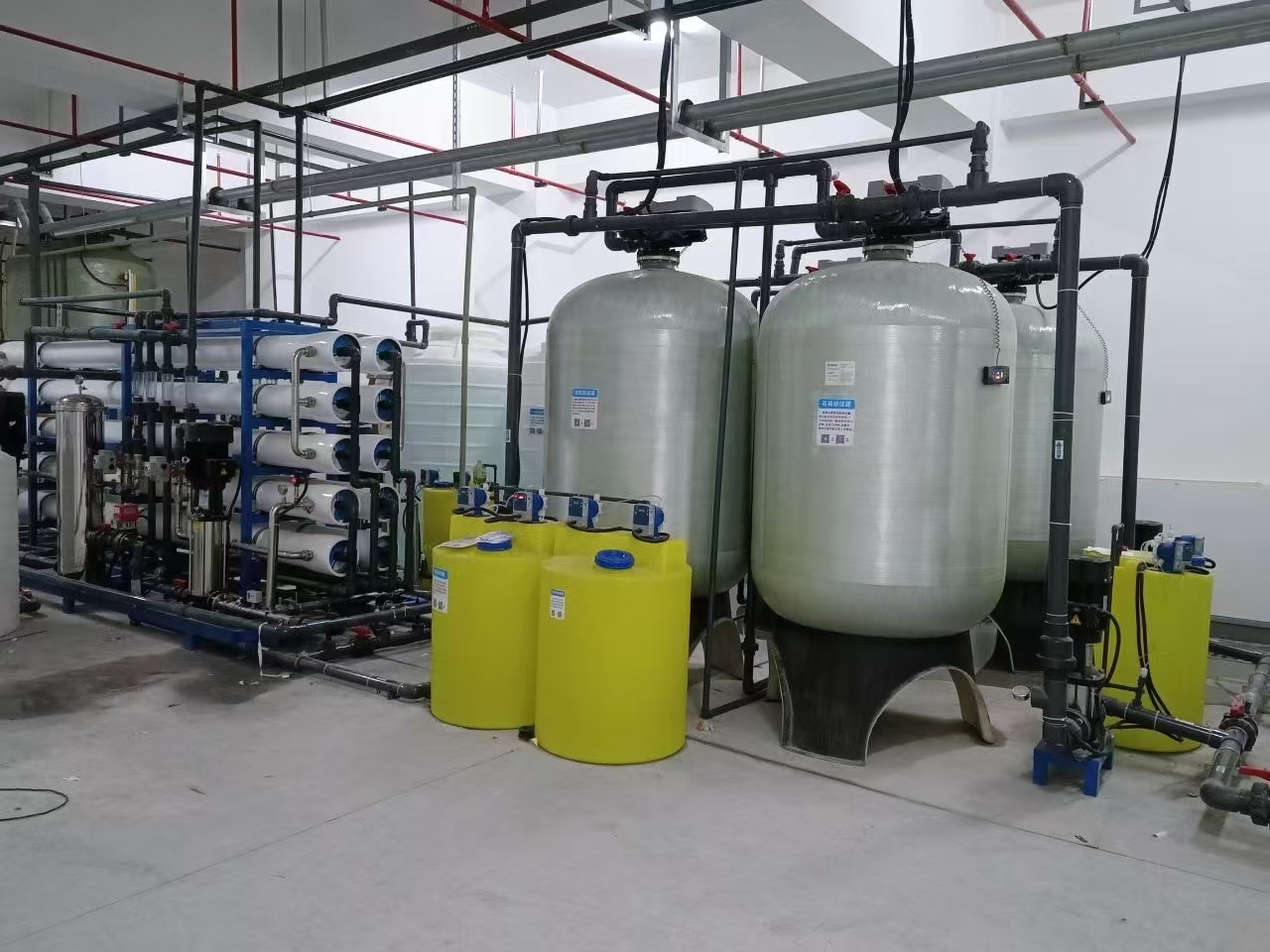
The 15 T/H EDI ultrapure water generation system is a high-purity water preparation solution designed for the electronic semiconductor manufacturing sector, with a standard output capacity of 15 tons per hour (equivalent to 15,000 liters per hour). This system employs a core desalination process combining "Continuous Electrodeionization (EDI) + Polishing Mixed Bed" technology, complemented by multi-stage pretreatment, two-stage reverse osmosis (RO), ultraviolet sterilization, and ultrafiltration for final purification. The resulting product water consistently achieves a resistivity of 18.25 MΩ·cm (at 25°C), approaching the theoretical limit for high-purity water, thereby meeting the stringent process requirements for ultrapure water used in electronic semiconductor cleaning applications.
This equipment features a modular, fully automated integrated design that progressively purifies raw water through multiple stages, complemented by a closed-loop circulation distribution system. This approach ensures high-quality end-product water while simultaneously guaranteeing operational stability, ease of maintenance and operation, and environmental sustainability (with a fully acid-and alkali-free regeneration process). Its rated water production capacity, water quality parameters, and system configuration are all optimized to meet the continuous, stable, and ultra-clean water supply requirements of the electronics and semiconductor industry; thus, it represents an ideal ultrapure water preparation solution for critical manufacturing processes such as wafer cleaning, photolithography, and wet etching.
In the electronic semiconductor manufacturing processes—such as those for integrated circuits, flat-panel displays, and photovoltaic devices—silicon wafers, substrates, and various electronic components undergo numerous high-frequency cleaning, rinsing, and etching operations. As one of the most extensively used process media, ultrapure water's cleanliness level directly determines product yield and device reliability. Even the presence of trace amounts of impurities in the water can lead to defects, contamination, or electrical failures on the surfaces of nanoscale devices.
Ultra-pure water used for electronic and semiconductor cleaning must meet extremely high standards across the following dimensions:
· Resistivity: Must exceed 18.2 MΩ·cm; this is the most critical indicator for measuring the concentration of dissolved ions in water. A resistivity of 18.25 MΩ·cm is close to the theoretical maximum resistivity for pure water (approximately 18.2–18.25 MΩ·cm at 25°C), indicating that there are virtually no free ions present in the solution.
· Particle control: Particles with a size of ≥0.05 μm must be strictly controlled; particle adhesion to device surfaces can cause pattern defects, short circuits, or wire breaks.
· Metal ions: Metal ions such as sodium, potassium, iron, copper, and zinc must be maintained at concentrations below 1 ppt (parts per trillion); even trace amounts of metal contamination can alter the carrier properties of semiconductors, leading to leakage current and device failure.
· TOC (Total Organic Carbon): Organic residues may carbonize or form a film during high-temperature processing, adversely affecting the quality of the oxide layer; for electronic-grade materials, the TOC level is typically required to be ≤ 20 ppb.
· Dissolved silicon (SiO₂): The deposition of silicon-based impurities on device surfaces can affect etching uniformity; the typical requirement is ≤ 0.5–1 ppb.
· Bacteria and microorganisms: Microbial metabolites as well as the microorganisms themselves can cause biological contamination; therefore, strict control measures—including ultraviolet sterilization and ultrafiltration—must be implemented.
· Special elements—such as boron and chlorine—pose significant hazards to certain devices (e.g., memory devices or photovoltaic cells) and must be removed specifically.
The water produced by this equipment meets the stringent requirements of internationally recognized electronic-grade ultrapure water standards, complying with the U.S. Electronic Grade Water Standard ASTM D5127 E-1.1 and SEMI F63 Grade 1 – specifically, 18.2 MΩ·cm electronic-grade ultrapure water. Below is a comparison of the key water quality parameters:
water-quality index | unit | This equipment produces water. | ASTM D5127 E-1.1 (Electronic Level 1) | SEMI F63 Grade 1 | explain |
resistivity | MΩ·cm ( 25℃ ) | 18.25 | ≥18.2 | ≥18.2 | Approximation Theory Limit |
TOC | ppb | ≤10 | ≤20 | ≤20 | Total organic matter |
Dissolved silicon (SiO₂) | ppb | ≤0.5 | ≤1 | ≤1 | Silicon-based impurities |
sodiumNa⁺ | ppb | ≤0.05 | ≤0.1 | ≤0.1 | metal ion |
chlorineCl⁻ | ppb | ≤0.05 | ≤0.1 | ≤0.1 | anion |
germ | CFU/mL | ≤0.1 | ≤0.1 | ≤0.1 | microbe |
Particulates (≥0.05 μm) | individual/mL | ≤1 | Strictly controlled | Strictly controlled | Particulate pollution |
Total particulate matter | — | Very low | Very low | Very low | Overall cleanliness level |
The above data indicate that the water produced by this equipment meets or exceeds the US Electronic Grade Water Standard requirements, making it suitable for use in high-end electronic semiconductor manufacturing processes with confidence.
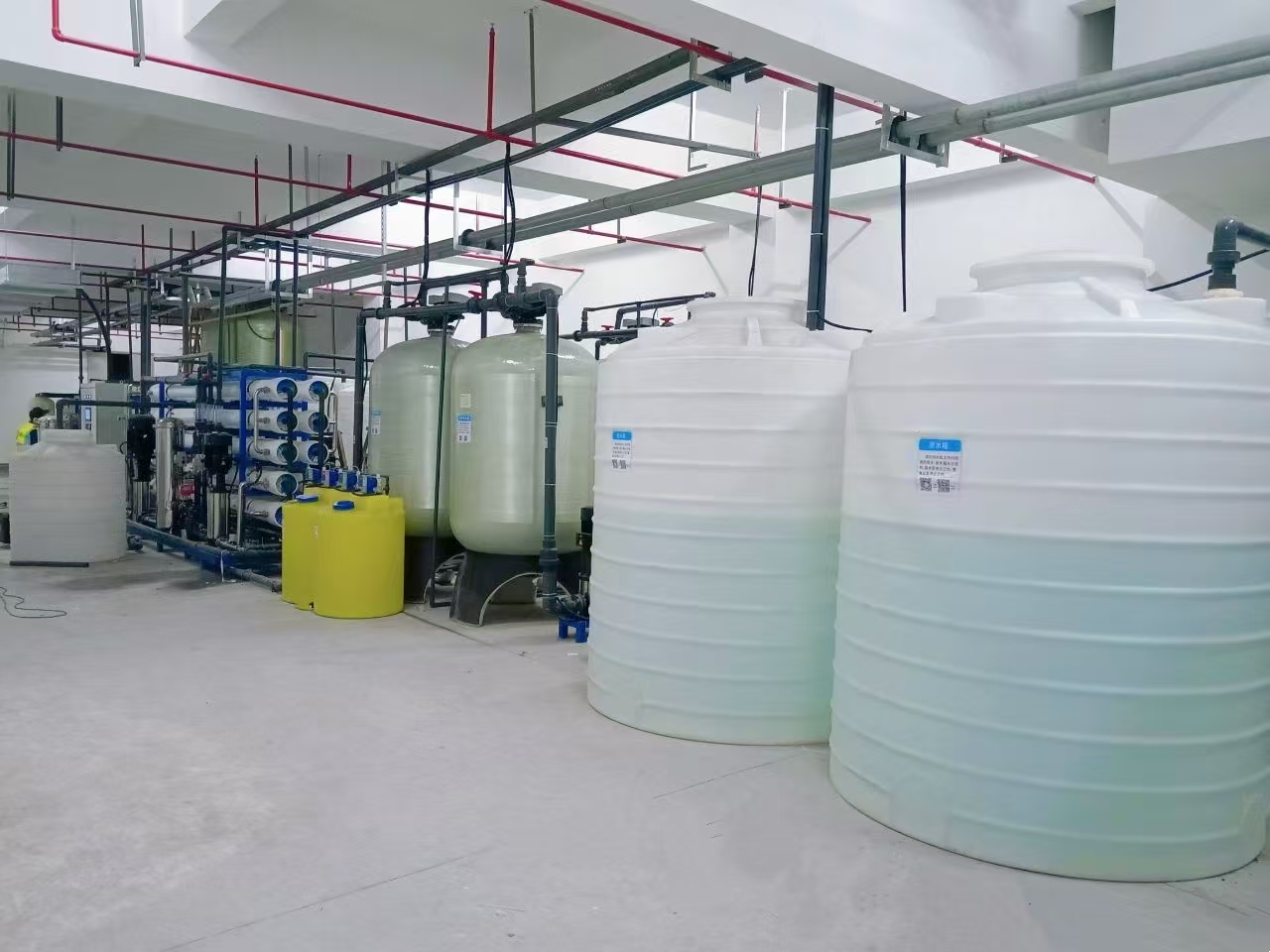
The 15 T/H EDI ultrapure water generation system employs a multi-stage progressive purification process to sequentially remove suspended solids, colloids, ions, organic compounds, microorganisms, and particulates, ultimately producing electronic-grade ultrapure water. The typical process flow is as follows:
Raw water → Multi-media Filtration → Activated Carbon Adsorption → Scale Prevention Dosage System (or Softening Filter) → Primary RO → Secondary RO → EDI (Electrodeionization) → Polishing Mixed Bed → 185 nm UV (TOC Reduction) → 254 nm UV (Disinfection) → UF (Ultrafiltration) → Ultra-Pure Water Nitrogen-Sealed Tank → Variable Frequency Drive (VFD) Circulating Water Supply → Microporous Terminal Filtration → Water Use Point
Description of each process unit:
· Pre-treatment stage (multi-media filtration, activated carbon treatment, water softening): removes suspended solids, residual chlorine, organic matter, and water hardness from the raw water to protect the subsequent membrane elements.
· Double-stage RO: As the primary desalination unit, it removes over 99% of dissolved salts, colloids, and most organic matter, providing qualified feedwater for EDI (typically with a conductivity ≤ 20 μS/cm).
· EDI (Electrodeionization): Under the influence of a DC electric field, residual ions are continuously removed using ion exchange membranes or resins, eliminating the need for acid-or alkali-based regeneration – making it an environmentally friendly process.
· Polished mixed-bed treatment: performs final deep purification of EDI effluent, further bringing the resistivity closer to the theoretical limit of 18.25 MΩ·cm.
· Dual-wavelength UV: 185 nm ultraviolet light oxidizes and decomposes macromolecular organic compounds into CO₂ and H₂O, thereby reducing the TOC; 254 nm ultraviolet light destroys microbial DNA, achieving sterilization.
· Circulating distribution: The ultrapure water tank, combined with a variable-frequency circulating water supply system and POU terminal filtration, helps suppress bacterial growth and prevent the decline in resistivity, ensuring stable water quality at all usage points.
The key configurations and technical specifications of this equipment are shown in the table below:
project | Parameters / Configuration |
Rated water output capacity | 15 T/H ( 15000 L/H ) |
Water resistivity | 18.25 MΩ·cm ( 25℃ ) |
TOC | ≤ 10 ppb |
ROratio of desalinization | ≥ 99% (double-stage cumulative) |
System water recovery rate | ≥ 75% |
Water intake requirements | Municipal tap water or raw water complying with GB 5749 |
pretreatment | Multi-media + Activated Carbon + Water Softening |
membrane system | Two-stage reverse osmosis (Stage I + Stage II RO) |
Deep desalination | EDI Module + Polishing Mixed Bed |
Sterilization and Purification | 185 nm/254 nm dual-wavelength UV + microporous filtration |
channel of distribution | Ultra-pure water nitrogen-sealed tank + Variable-frequency constant-pressure circulating water supply system |
end-filtration | Micro-porous terminal filter |
installed power | Approx. 18–25 kW (depending on configuration) |
control method | PLC-based fully automatic system + Touchscreen + Online water quality monitoring (resistivity, flow rate, pressure) |
material quality | The ultrapure water section utilizes cleanroom-grade materials such as SS316L, PVDF, and UPVC. |
· Excellently stable water quality: The resistivity remains consistently at 18.25 MΩ·cm, with all parameters complying with the US Electronic Grade 1 Water Standard – ideal for high-end semiconductor manufacturing processes.
· Environmental friendly and acid/alkali-free: The core desalination process employs continuous EDI (Electrodeionization) regeneration technology, replacing traditional mixed-bed acid/alkali regeneration methods; this eliminates the discharge of chemical wastewater, thereby complying with green factory requirements.
· Fully automated operation: Centralized PLC control enables real-time monitoring of critical water quality and operational parameters, along with self-diagnosis and alarm functionality, thereby reducing manual intervention and operational maintenance workload.
· High water recovery rate and energy efficiency: The dual-stage RO system features an optimized circulating distribution design, achieving a system water recovery rate of ≥ 75%, effectively reducing water consumption and operating costs.
· Modular and scalable: The standardized module design facilitates installation, expansion, and maintenance, making it suitable for production lines of varying sizes.
· Cleanliness Assurance: The ultrapure water contact components are fabricated from clean-grade materials with low leaching and anti-fouling properties, effectively preventing secondary contamination at the source.
This equipment is widely适用于 applications requiring extremely stringent water quality standards in the electronics, semiconductor, and related high-end manufacturing sectors, including:
· Water for integrated circuit (IC) wafer cleaning, photolithography, and wet etching processes;
· Glass substrate cleaning water for flat-panel displays (LCD/OLED);
· Water for texturing, cleaning, and pre-diffusion cleaning of photovoltaic silicon wafers;
· High-purity rinsing water for electronic components and precision devices;
· Ultra-pure water demand in fields such as laboratories, pharmaceuticals, and advanced surface treatment applications.
In terms of system selection value, the 15 T/H production capacity is well-suited to meet the continuous water demand of medium-scale electronic and semiconductor manufacturing lines; the process route, centered on the EDI + polishing mixed-bed system, ensures exceptional water quality of 18.25 MΩ·cm while eliminating the environmental and operational risks associated with acid–alkali regeneration; the stable circulating distribution system guarantees consistent water quality at all usage points, thereby helping to improve product yield and reduce the cost per unit of water produced – making it an ideal solution that balances advanced technology with commercial viability.
To ensure the long-term stable operation of the equipment and the quality of the produced water, it is recommended to adhere to the following operational and maintenance guidelines:
· Regular monitoring: Conduct daily inspections of online resistivity, TOC, flow rate, and pressure; maintain a water quality logbook; and promptly investigate any detected anomalies.
· Pre-treatment maintenance: Replace the multi-media filter, activated carbon, and softening resin periodically; monitor the residual chlorine and hardness of the influent water to prevent oxidation or scaling of the membrane elements.
· Membrane system maintenance: Regularly monitor the operating pressure differential between the RO and EDI units as well as the product water conductivity; perform chemical cleaning when necessary to extend the service life of the membrane elements.
· Sterilization Management: Regularly calibrate the UV lamp intensity and replace the lamps as scheduled; ultrafiltration and terminal filters should be replaced based on pressure differential or periodic intervals to prevent microbial growth.
· Circulation assurance: Maintain continuous circulation within the distribution system to prevent stagnant water from causing a decrease in resistivity or bacterial growth.
· Record Keeping and Training: Improve operational and maintenance documentation; provide professional training for operators to ensure standardized operating procedures and effective emergency response capabilities.
Through the aforementioned scientific operation and maintenance practices, the 15 T/H EDI ultrapure water system can consistently and reliably produce electronic-grade ultrapure water with a resistivity of 18.25 MΩ·cm, providing a reliable water quality assurance for electronic and semiconductor cleaning processes.


Tel