Hello! Welcome to visitShanghai Bosen Environmental Technology Co., LtdOfficial website!
Specialized for aluminum product manufacturing and processing · Pure water system that leaves no water stains after cleaning
Water output: 2000 L/h (2 tons per hour)
Water conductivity: ≤ 15 μS/cm (25°C)
This equipment is a 2000 L/h single-stage reverse osmosis pure water system with a rated production capacity of 2000 L/h (2 tons per hour). The produced water's conductivity remains consistently ≤ 15 μS/cm (at 25°C), and the system's desalination rate is ≥ 97%. The system employs a proven process combining "pre-treatment + single-stage RO + final polishing treatment and constant-pressure water supply," specifically designed for the cleaning of aluminum components in aluminum manufacturing processes. This ensures that no water residues remain on the surfaces of cleaned aluminum parts, meeting the process requirements for a clean substrate in surface treatment applications (such as anodizing or spraying).
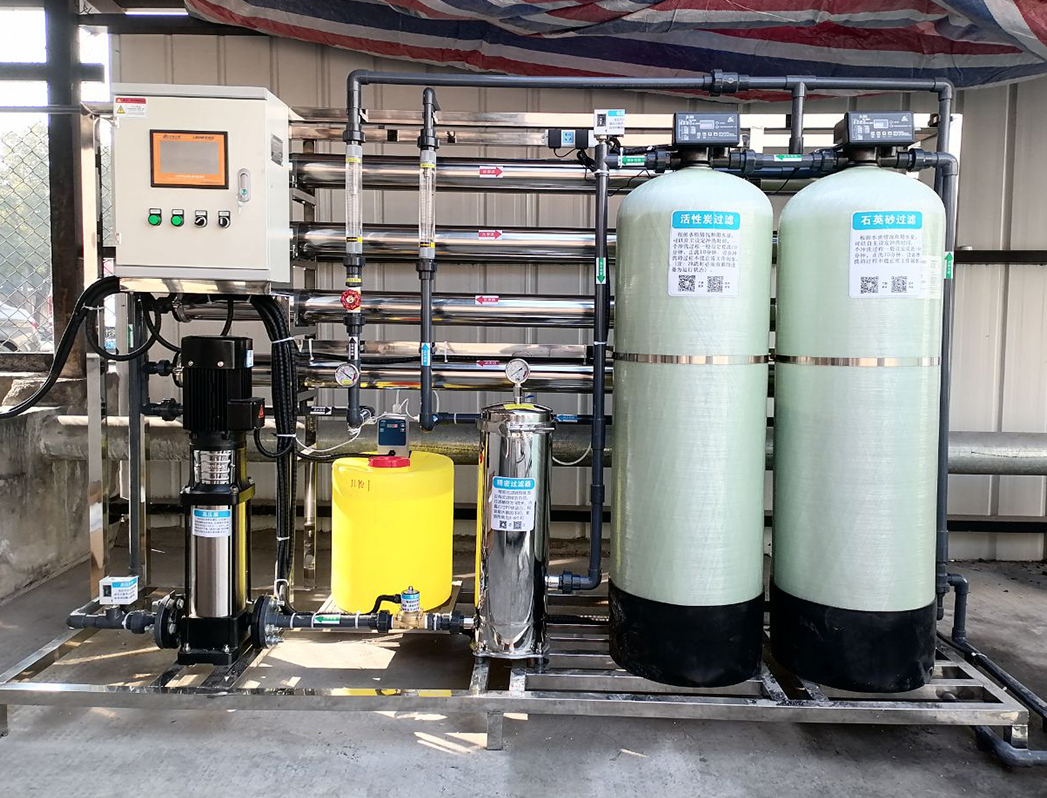
The 2000 L/h single-stage reverse osmosis pure water system is a standardized pure water production system designed for small-to-medium-scale industrial water application scenarios. Its rated water production capacity is 2,000 liters per hour (equivalent to 2 tons per hour), and the output water meets water quality standards with a conductivity of ≤15 μS/cm, making it suitable for process stages that require high water quality, such as aluminum product manufacturing, electronic component cleaning, surface treatment, food and beverage production, and laboratory solution preparation. This system uses municipal tap water or groundwater subjected to simple sedimentation as raw water and employs a proven process sequence—comprising "pre-treatment + single-stage reverse osmosis (RO) + final polishing treatment + constant-pressure water supply" —to effectively remove suspended solids, colloids, dissolved salts, microorganisms, and organic matter from the raw water, thereby delivering stable, clean industrial pure water.
Compared to traditional water softening and distillation methods, the single-stage reverse osmosis process offers significant advantages, including lower operating costs, elimination of the need for frequent acid-alkali regeneration, absence of secondary pollution, high degree of automation, and ease of start-up and shutdown. For aluminum manufacturing enterprises with an hourly water production capacity ranging from 1 to 5 tons, a 2000 L/h single-stage reverse osmosis pure water system offers excellent cost-effectiveness and scalability—whether in terms of initial investment, footprint requirements, or daily operation and maintenance—making it one of the most widely adopted and reliable pure water solutions for aluminum part cleaning, rinsing, and pre-treatment processes.
Throughout the aluminum product manufacturing and processing chain – whether it involves surface cleaning after aluminum profiles have been extruded, degreasing and rinsing of aluminum sheets, strips, or foils, or the spray cleaning and final washing of aluminum die-cast parts – the quality of the water directly impacts the product's surface appearance and the yield rate of subsequent processing steps. Ordinary tap water contains a relatively high concentration of soluble ions—such as calcium, magnesium, sodium, chloride, and sulfate—as well as small amounts of silicates. When aluminum components are washed and then naturally dried or dried in a drying oven, the moisture adhering to their surfaces evaporates, leaving behind dissolved salts and ions on the component surfaces; these substances then crystallize, forming visible white spots, water stains, or hazy marks.
This "water stain" issue poses hazards to aluminum products in two ways: firstly, on appearance-oriented components and decorative aluminum materials, white spots and water stains can severely compromise the surface gloss and cleanliness, leading to product downgrading or even rejection; secondly, on aluminum parts that require anodic oxidation, electrophotography, spraying, or bonding processes, residual ions and salts can undermine the uniformity and adhesion of the oxide film, giving rise to quality defects such as color variation, pinholes, blistering, or paint peeling – all of which directly impact the yield rate and corrosion resistance of the final surface-treated products.
Using pure water with a conductivity of ≤15 μS/cm for both initial and final cleaning processes effectively addresses the issue of water stains at the source. The extremely low concentration of dissolved salts and ions in pure water leaves virtually no residue on the aluminum surface after drying, ensuring that "no water stains remain on the aluminum surface after cleaning." This not only safeguards the aesthetic quality of the aluminum components but also provides a clean, stable substrate surface for subsequent processing steps such as anodizing and coating. Therefore, in the aluminum manufacturing industry, installing a pure water system that delivers consistently compliant water quality has become a fundamental measure for enhancing product consistency and yield.
This equipment employs a classic three-stage process sequence – "Pre-treatment System → Single-Stage Reverse Osmosis Unit → End-Stage Final Treatment and Constant Pressure Water Supply System" – where all units operate in coordination to ensure that the produced water consistently meets all regulatory requirements.
The raw water first enters the pretreatment system. The multi-media filter removes silt, rust, suspended solids, and colloids from the raw water through the physical interception and adsorption effects of filter media such as quartz sand and anthracite; the activated carbon filter utilizes the abundant microporous structure of activated carbon to adsorb residual chlorine, odors, and certain organic compounds from the water, thereby protecting the subsequent reverse osmosis membranes from oxidation and contamination; the security filter (precision filter, typically equipped with a 5 μm filter element) serves as the final physical barrier, intercepting any particles that may have leached from the pretreatment stage to prevent scratching or clogging of the RO membrane elements.
The pretreated water is pressurized by a high-pressure pump to an appropriate operating pressure and then fed into the single-stage reverse osmosis unit. Driven by pressure, the reverse osmosis membrane allows water molecules to pass through while retaining the vast majority of dissolved salts, ions, organic compounds, and microorganisms; the desalination rate typically exceeds 98%, thereby converting the raw water into pure water with a conductivity of ≤15 μS/cm. The system is equipped with concentrated water discharge and reflux regulation features, which ensure a high recovery rate while simultaneously controlling the membrane surface fouling rate.
The pure water produced by reverse osmosis is directed to the final polishing and distribution system. Depending on the water usage requirements, a pure water storage tank can be installed for buffer storage, supplemented by a UV sterilizer or ozone disinfection system to inhibit microbial growth; a constant-pressure water supply pump operated under variable-frequency drive ensures stable water pressure and continuous flow rate at all water usage points. For applications requiring higher water quality standards, a polishing mixed-bed or EDI module can be added after the RO unit to perform advanced desalination, further reducing the water conductivity.
The main technical specifications of this equipment are listed in the table below; the specific values can be adjusted accordingly based on the raw water quality and on-site operating conditions:
project | parameter declaration |
unit type | Single-stage reverse osmosis pure water treatment system |
Rated water output capacity | 2000 L/h (2 tons per hour) |
Raw water requirements | Municipal tap water or compliant groundwater – turbidity ≤ 5 NTU, residual chlorine ≤ 0.1 ppm |
Water product quality | Conductivity ≤ 15 μS/cm (25°C) |
System desalination rate | ≥98% |
Inlet pressure | 0.2 ~ 0.4 MPa |
ROworking pressure | 1.0 ~ 1.6 MPa |
Recycling Rate | 50% ~ 65% |
pretreatment | Multi-media filtration + Activated Carbon Filtration + 5 μm Safety Filtration |
reverse osmose membrane | Imported / Domestic卷式RO Membrane Elements |
high lift pump | Stainless steel multi-stage centrifugal pump |
Control System | PLC-controlled automatic operation with water level protection, high/low voltage protection, and automatic flushing function |
source | 380 V/50 Hz (Three-phase, four-wire) |
installed capacity | Approximately 3–4 kW |
outline dimension | Based on the modular design: approximately 2000 × 800 × 1800 mm (Reference) |
Among the aforementioned parameters, the raw water conductivity ≤ 15 μS/cm is the core criterion for equipment selection and acceptance; this requirement must be consistently met under normal raw water quality conditions and during the stable operation of the system.
This equipment offers multiple performance advantages tailored for aluminum product processing applications. First, it ensures stable and reliable water quality: the single-stage RO process features a high rejection rate for dissolved salts and ions; when combined with real-time monitoring using an online conductivity meter, it guarantees that the conductivity of the produced water remains consistently ≤15 μS/cm, thereby eliminating water residue issues after the cleaning of aluminum components at the source. Second, it boasts a high degree of automation – the system employs PLC-based programmable control and incorporates features such as automatic water generation, automatic flushing, shutdown upon water shortage, high/low pressure protection, and fault alarm functionality, reducing reliance on operators and minimizing the risk of human error. Third, it is economically efficient: unlike ion exchange processes, it does not require acid-or alkali-based regeneration nor generates hazardous waste; for routine maintenance, only periodic replacement of filter cartridges and membrane elements is necessary, significantly lowering operating costs and environmental impact. Fourth, it features a compact design and easy installation – most units adopt a pedestal-mounted integrated design, with piping and electrical systems integrated into the machine frame; the system can be put into operation simply by connecting water and power supplies on-site, saving factory space. Fifth, it offers strong scalability – it includes reserved interfaces for a pure water tank, sterilization, and advanced treatment, allowing for flexible expansion to meet future production capacity increases or water quality upgrade requirements.
The 2000 L/h single-stage reverse osmosis pure water system is widely used across various stages of aluminum product manufacturing and processing: for the rinsing and final washing of aluminum profiles, sheets, strips, and foils after surface degreasing; for the spray cleaning and pure water rinsing of aluminum die-cast parts and machined aluminum components; for preparing solutions and supplying water for surface treatment processes such as anodizing, electrophoresis, and spraying; as well as for cleanroom flushing in workshops and for preparing solutions and supplying cooling water in laboratories. For aluminum product manufacturing enterprises with moderate daily cleaning volumes and stringent water stain control requirements, this equipment can, with a reasonable investment, consistently meet the critical process requirement of "ensuring no water stains remain on aluminum parts after cleaning."
From a selection value perspective, this equipment enables users to obtain stable, compliant pure water at a controllable cost, thereby reducing product degradation and rework caused by water contamination or white spots, and enhancing the yield and consistency of downstream processes such as anodic oxidation and spraying; simultaneously, it eliminates the acid–alkali contamination and complex maintenance associated with traditional water treatment methods, aligning with corporate requirements for green manufacturing and compliant emissions. For small and medium-sized aluminum processing enterprises currently expanding their production capacity or upgrading their product offerings, the 2000 L/H water production capacity not only meets current demand but also offers an excellent return on investment – making it a rational choice that balances quality, cost, and sustainability.
To ensure the long-term stable operation of the equipment and the continuous compliance of the product water quality with regulatory requirements, it is recommended that users pay attention to the following operational and maintenance considerations. First, replace the pretreatment filter media and filter elements regularly: multi-media and activated carbon filter media should generally be replaced every 1–2 years; 5 μm security filter elements should be replaced every 3–6 months, depending on the raw water quality and operating duration. Second, monitor the operating status of the RO membranes: when the product water conductivity continues to rise, the product water flow rate decreases significantly, or the inter-stage pressure differential increases, check whether chemical cleaning or membrane element replacement is necessary; typically, the service life of membrane elements is 2–3 years. Third, ensure that the automatic flushing and protection functions are operating correctly: the automatic flushing performed before each system shutdown can effectively reduce concentration polarization and fouling on the membrane surface; regularly verify that the flushing solenoid valves and associated piping are clear and unobstructed. Fourth, implement proper hygiene management for the pure water tank and water supply piping: clean the pure water tank regularly and utilize ultraviolet or ozone disinfection to prevent secondary contamination that could lead to excessive microbial levels. Fifth, maintain detailed records of raw water quality and operational data to facilitate the tracing of anomalies, optimize the replacement schedules for chemicals and consumables, and achieve refined management throughout the entire equipment lifecycle.


Tel