Hello! Welcome to visitShanghai Bosen Environmental Technology Co., LtdOfficial website!
Water resistivity ≥ 18.25 MΩ·cm (25°C) | Pilot-scale validation of the ultrapure water system for production line
Water production rate: 250 L/h; Resistivity: 18.25 MΩ·cm; Dual-stage RO + EDI + Polishing Mixed Bed with Acid-Base Continuous Regeneration; PLC-controlled fully automatic system.
This equipment is a modular ultrapure water (UPW) generation system designed for pilot-scale production lines, with a rated output capacity of 250 L/h and a stable water resistivity of 18.25 MΩ·cm (at 25°C) – corresponding to the water quality grade defined by the theoretical maximum conductivity of pure water (0.055 μS/cm). The system employs a proven process chain comprising "pre-treatment + dual-stage reverse osmosis (RO) + EDI (Electrodeionization) + polishing mixed bed + UV sterilization + final filtration"; its effluent meets the stringent requirements for trace ions, TOC, particulates, and microorganisms in pilot-scale validation and precision cleaning applications across the electronics, pharmaceutical, and chemical industries.
With equipment as the core design objective, the EDI section employs DC power to drive continuous desalination, while the polishing mixed-bed serves as the final refinement step; together, these technologies overcome the theoretical upper limit of single-stage EDI (typically 5–18 MΩ·cm), ensuring long-term compliance with the 18.25 MΩ·cm specification.
250 L/h rated water output (20°C)
18.25 MΩ·cm – Electrical resistivity (25°C)
≥ 75% overall system recovery rate
0 Acid–Base EDI Continuous Regeneration
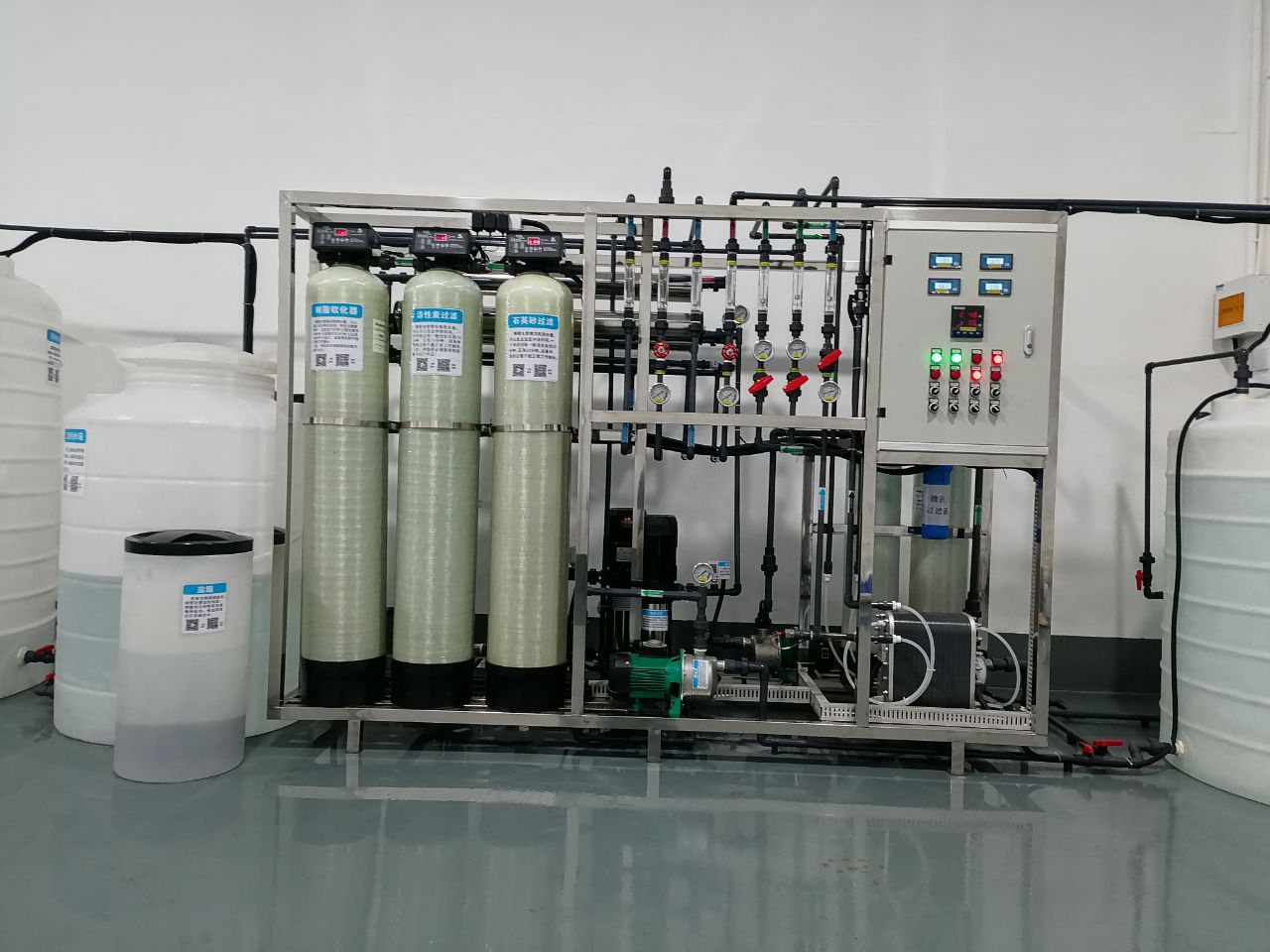
To maintain a consistent water quality of 18.25 MΩ·cm, the system employs a six-stage stepwise desalination process. The water quality changes at each stage are as follows:
Raw water → Raw water tank/泵 → Multi-media filtration → Activated carbon filtration → Softener → Protective filter (5 μm) → Primary RO → Secondary RO → RO intermediate water tank → EDI module → Polishing mixed bed → UV disinfection → Final 0.22 μm filtration → Ultra-pure water tank → Water usage point
Process Section | Inlet water quality | Water discharge quality | Primary target of removal |
Multi-media + Activated Carbon + Water Softening | Municipal/Underground Water | SDI <4; residual chlorine ≈ 0; hardness ≈ 0 | Suspended solids, colloids, residual chlorine, organic matter, hardness |
one-levelRO | Pre-treated water product | Conductivity: 5–20 μS/cm | ≥98% dissolved salts, colloids, microorganisms |
Secondary RO | Primary RO treated water | Conductivity: 1–5 μS/cm | Further desalination; TOC pretreatment |
EDI | ≤5 μS/cm | Resistivity: 15–17 MΩ·cm | Continuous deep demineralization (anion/cation) |
Polished mixed bed | EDI Water Treatment | Resistivity: 17.5–18.25 MΩ·cm | Trace Ion Ultimate Exchange (Nuclear-Size Resin) |
UV + Terminal Filtration | Polished water output | TOC <5 ppb; bacteria <1 CFU/mL | Organic matter degradation, microbial/颗粒截留 |
• Raw water tank + raw water pump: Buffers fluctuations in raw water supply and maintains a constant water supply pressure (≥0.25 MPa).
• Multi-media Filter: Quartz sand/anthracite filter media for removing suspended solids, iron and manganese colloids, and reducing the SDI.
• Activated carbon filter: Adsorbs residual chlorine and organic compounds to protect the subsequent RO membrane (residual chlorine concentration must be <0.1 ppm).
• Softener: Sodium-based cation exchange resin for removing Ca²⁺/Mg²⁺ hardness and preventing scaling in RO/EDI systems.
• Security filter: 5 μm melt-blown filter element – intercepts leakage particles from the upstream section, protecting the high-pressure pump and membrane elements.
• Two-stage RO: First-stage desalination ≥98%; second-stage further refined desalination; total desalination rate> 99.5%.
• High-pressure pump: Each stage is equipped with a vertical stainless steel pump, optionally paired with a variable-frequency drive or energy recovery system for energy efficiency.
• Membrane elements: Wound aromatic polyamide composite membranes (e.g., DOW/Times Warford), anti-fouling design.
• Concentrated wastewater recycling: Secondary concentrate can be recycled back into the raw water tank, increasing the overall recovery rate of the pumping system to over 75%.
• Membrane stack configuration:淡水室(filled with mixed ion-exchange resin)+ concentrate room, separated by alternating anion/cation exchange membranes.
• Operating voltage/current: DC power supply (typically 0–600 V / mA), with constant-current or constant-voltage operation.
• Continuous regeneration: The DC electric field drives the directional migration and removal of ions; the resin does not require acid-or alkali-based regeneration.
• Inlet water conditions: conductivity ≤ 20 μS/cm, hardness <1 ppm, TOC <0.5 ppm, temperature 5–45°C.
• Polished mixed-bed: Nuclear-grade cation and anion resins (mixed in a 1:1 ratio) – increased resistivity from ~17 MΩ·cm to 18.25 MΩ·cm.
• UV sterilizer (185/254 nm): 254 nm germicidal action; 185 nm degradation of TOC <5 ppb.
• Terminal filter: 0.22 μm (or 0.1 μm) bag-type filter element, which intercepts particles and bacteria to ensure the purity of the point-of-use water.
• Ultra-pure water tank: Made of PE or stainless steel (inert material); equipped with a nitrogen-sealed or breathing filter to prevent secondary contamination; features a recirculation design.
EDI (Electrodeionization) is a coupled technology combining electrodialysis and ion exchange. Under the influence of a direct current electric field:
1. The anions and cations in the freshwater chamber migrate directionally toward the positive and negative electrodes, respectively, under the influence of the electric field;
2. Cations pass through the cation-selective membrane, while anions pass through the anion-selective membrane into the adjacent concentrate chamber;
3. The ion exchange resin filled in the freshwater chamber accelerates ion conduction and captures migrating ions;
4. Water undergoes slight hydrolysis (water cleavage) on the resin surface, generating H⁺/OH⁻ ions, thereby regenerating the resin in situ and enabling continuous self-regeneration;
5. The concentrated stream, after ion enrichment, is discharged or recycled; the freshwater chamber continuously produces high-purity water.
Compared to traditional mixed-bed systems, EDI does not consume acids or bases, eliminates the discharge of acidic or alkaline wastewater, and allows for continuous operation – making it the mainstream approach in green ultrapure water technology. However, it requires a high inlet water purity; therefore, a two-stage RO pre-treatment system is necessary; for the final stage (resistivity of 18.25 MΩ·cm), a polishing mixed-bed system is still employed as a backup.
Parameter Term | metric | remarks |
Rated water production capacity | 250 L/h | 20°C – Calibration |
Water resistivity | ≥ 18.25 MΩ·cm ( 25℃ ) | Online resistivity meter monitoring |
System recovery rate | ≥ 75% | Including secondary concentrated wastewater reflux |
Raw water requirements | Municipal tap water / Groundwater – SDI <5 | Hardness and residual chlorine levels have been adjusted to meet the required standards after pretreatment. |
ROratio of desalinization | 99.5% (Total for two-stage process) | Level 1 + Level 2 |
EDI operating voltage/current | 0–600 V / Adjustable Amperes | constant-current control |
source | AC 380V / 50Hz (Three-phase) | Total power: approximately 2.5–4 kW |
work environment | 5–40°C, humidity ≤ 80% RH | Indoor environment; no corrosive gases |
Equipment Dimensions (Reference) | Approx. 2.0 × 0.9 × 1.8 m (Integrated rack) | Includes pretreatment and purification stages |
control method | PLC + Touch HMI – Fully Automatic | Network/Remote Interface |
The produced water meets the typical requirements for laboratory/industrial-scale ultrapure water (closely aligning with GB/T 11446.1 EW-Ⅰ and ASTM D1193 Type I):
metric | Water production typical value | Unit / Description |
resistivity | 18.25 | MΩ·cm @ 25℃ |
conductivity | ≤ 0.055 | μS/cm |
TOC | < 5 | ppb (after UV degradation) |
total number of bacteria | < 1 | CFU/mL |
Particulate matter (≥0.22 μm) | < 1 | µL/mL (after final filtration) |
SiO₂ | < 2 | ppb |
Na⁺ | < 0.5 | ppb |
Cl⁻ | < 0.5 | ppb |
dissolved oxygen | Customizable (optional degassing available) | PPB level (additional configuration required for low-oxygen conditions) |
If the pilot-scale process imposes extremely stringent requirements on metal ions (e.g., Cu, Fe, Zn) or boron (B), a dedicated boron-and metal-removal fine-column may be installed after the polishing stage, or a degassing membrane (membrane degassing) may be added to further reduce dissolved oxygen and CO₂ levels.
• Two-stage RO + EDI + polishing mixed-bed system – stable resistivity of 18.25 MΩ·cm
• Continuous water production with minimal water quality fluctuations, ideal for long-term pilot-scale operation
• Low TOC, low particulate matter, and low microbial contamination risk
• EDI acid–base regeneration – no waste acid or base discharge – environmentally friendly
• High level of automation, minimal human intervention, and low operational and maintenance costs
• Modular integration – compact footprint, facilitating the setup and relocation of pilot-scale workshops
• PLC + Touchscreen HMI: One-touch start/stop, automatic flushing, fault self-diagnosis and alarm.
• Online instruments: water resistivity/conductivity meter, flowmeter, pressure transmitter, RO feedwater conductivity, pH (optional).
• Safety Interlock: Low-pressure/high-pressure protection, pump dry-run protection, water tank level linkage, and EDI water shortage power-off protection.
• Data logging: Historical storage of operational parameters; supports USB/Ethernet export for ease of pilot-scale testing.
project | Cycle / Requirements |
Pre-treatment filter media | Multi-media filter: replace every 1–2 years; Activated carbon: replace every 1 year; Softening resin: regenerate according to water hardness (automatic salt tank) |
Security filter element | 5 μm filter element – Replace every 3–6 months (based on pressure differential) |
ROmembrane | Periodic Clean-in-Place (CIP) – typical service life: 2–3 years |
EDI Membrane Stack | No regeneration required; maintenance based on influent conditions; service life: 3–5 years |
Polished mixed bed | When the resistivity falls below 18 MΩ·cm, replace with nuclear-grade resin. |
UV lamp / Terminal filter cartridge | UV lamp: 1 year; 0.22 μm filter element: 6–12 months (depending on flow rate/pressure drop) |
Installation Requirements | Level the ground; ensure water inlet, drainage, power supply, and floor drains are in place; indoor temperature: 5–40°C |
• Pilot-scale validation line: Pilot-scale scale-up of ultrapure water supply and water quality validation for new processes and new materials.
• Electronic semiconductors: High-purity water for cleaning, development, and wet processing applications (sensitive to trace metals).
• Pharmaceuticals and Biotechnology: Pre-treatment of Water for Injection (WFI), formulation preparation, and laboratory analysis.
• Chemicals and Energy: Applications requiring high-purity water – e.g., battery materials, catalysts, surface treatment, etc.
• Analytical testing: ICP-MS, HPLC, TOC analysis, and other trace-level detection methods – requiring ultrapure water.


Tel