Hello! Welcome to visitShanghai Bosen Environmental Technology Co., LtdOfficial website!
High-purity water preparation system for the production of food flavors and fragrances
catalogue
Equipment Overview
High-purity water demand in the food flavoring and fragrance industry
System Process Principles and Flowchart
Main Specifications and Technical Parameters
Equipment Performance Features
Application Scenarios and Selection Value
Operational and Maintenance Key Points
Rated water output capacity 2000 L/H | Water resistivity ≥16 MΩ·cm | Water inlet type Municipal water supply |
This equipment is custom-designed for the production of food flavors and fragrances, with a rated water output of 2000 L/h and a stable water resistivity of ≥16 MΩ·cm (at 25°C).
This multi-stage process – comprising "pre-treatment + dual-stage RO + continuous EDI desalination + polishing mixed bed/UV sterilization" – eliminates the need for acid-or alkali-based regeneration, features a high degree of automation, and ensures that the effluent water quality meets the stringent requirements for controlling ions, microorganisms, and organic compounds as specified by the high-end fragrance and flavor industry.
The 2000 L/h EDI ultrapure water system is a medium-sized high-purity water preparation system designed and manufactured for food flavor and fragrance manufacturers. With a rated output capacity of 2,000 liters per hour (equivalent to 2 tons per hour), it employs a combined process route comprising "pre-treatment + dual-stage reverse osmosis (RO) + continuous EDI electrodeionization + polishing mixed bed/sterilization." The final product water maintains a stable resistivity of ≥16 MΩ·cm (at 25°C), meeting the stringent high-purity water quality requirements inherent in the food flavor and fragrance industry.
This equipment is centered on automated control and integrates functions such as PLC program control, online water quality monitoring, automatic flushing, and fault alarm systems, enabling continuous and stable operation without the need for frequent replacement of acid-or alkali-regenerated resins. This not only reduces the workload on operating personnel but also eliminates the chemical wastewater discharge issues associated with traditional ion exchange processes, aligning with the evolving trends of clean production and green manufacturing in the food industry.
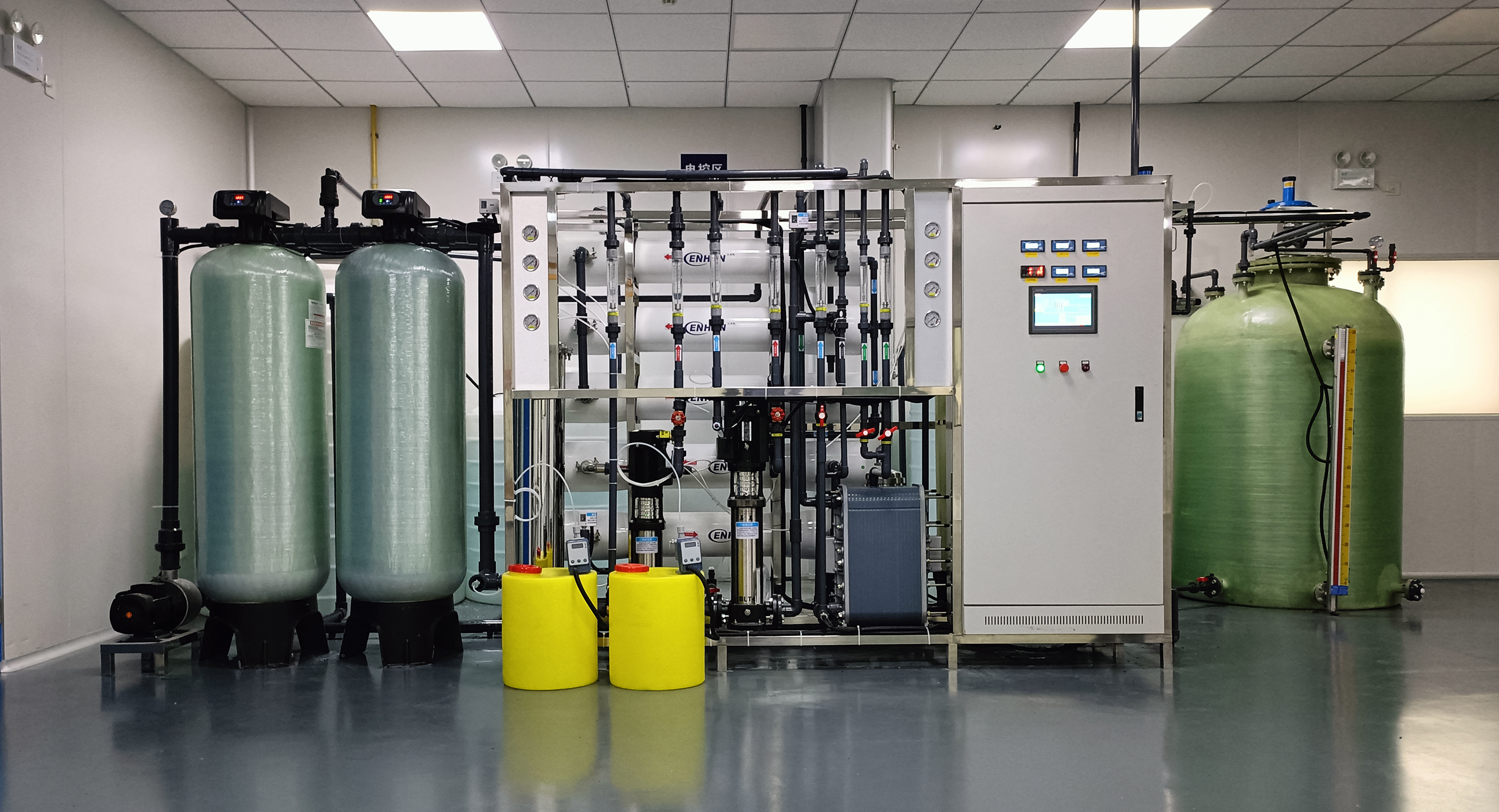
The water quality requirements for food flavor and fragrance production are significantly more stringent than those for general industrial water applications. During processes such as flavor formulation, fragrance extraction, reaction vessel cleaning, product dissolution, and laboratory testing, trace amounts of ions, microorganisms, organic compounds, or particulate impurities in the water can directly impact the product's flavor stability, color purity, and shelf life.
First, metal ions in water (such as calcium, magnesium, iron, copper, etc.) can react with esters, aldehydes, and phenolic compounds present in the fragrance, triggering oxidation and color changes that may distort the product's aroma or even introduce undesirable odors. Second, excessive microbial levels can lead to the deterioration of the fragrance system, posing food safety risks. Third, elevated levels of Total Dissolved Solids (TDS) or conductivity can alter the ionic environment of the solution, interfere with the accurate reproducibility of the formulation, and compromise batch-to-batch consistency.
Therefore, food flavor and fragrance manufacturers generally require that the conductivity of pure water approaches zero and its resistivity is ≥15 MΩ·cm, while also implementing strict control over microorganisms and particulate matter at the water intake point. This equipment elevates the water resistivity specification to ≥16 MΩ·cm and is equipped with UV sterilization and terminal filtration systems, thereby better meeting the stringent water purity requirements for high-end flavor and fragrance products.
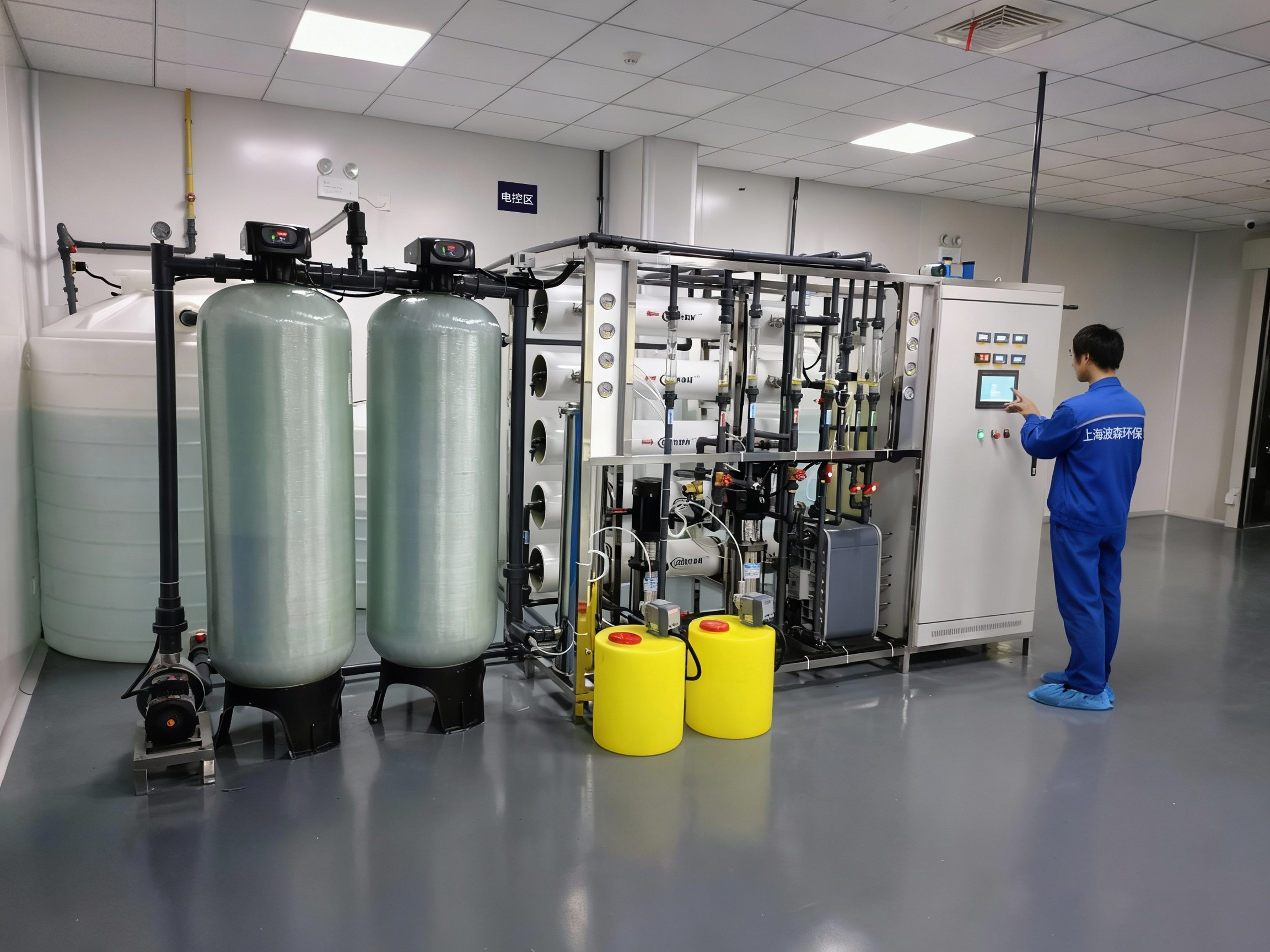
This equipment employs a multi-stage progressive purification process to sequentially remove suspended solids, colloids, hardness, dissolved salts, and organic matter from the raw water, ultimately producing high-purity treated water. The complete process flow is as follows:
Raw water → Multi-media Filter → Activated Carbon Filter → Scale inhibition/softening filter → Security Filter → Primary High-Pressure Pump → Primary Reverse Osmosis (RO) → Secondary High-Pressure Pump → Secondary Reverse Osmosis (RO) → EDI Module → Polishing Mixed Bed → UV Sterilization → Final Precision Filtration → Pure Water Storage Tank → Water Distribution Point
1. Pre-treatment unit: A multi-media filter removes suspended solids such as sand, sediment, and rust; an activated carbon filter adsorbs residual chlorine and organic compounds to protect the subsequent RO membrane; a water softener or scale inhibitor system reduces calcium and magnesium hardness to prevent scaling on the membrane surface.
2. Dual-stage reverse osmosis (RO): The first-stage RO removes approximately 98% of dissolved salts; the second-stage RO further purifies the water, reducing the conductivity on the freshwater side to the range of 1–5 μS/cm, thereby providing suitable feedwater conditions for EDI.
3. EDI Continuous Electrodeionization: Under the influence of a direct current electric field, in combination with ion exchange resins and selective ion exchange membranes, residual ions in the RO product water are continuously removed; this process yields pure water with a resistivity of 15–18 MΩ·cm without the need for chemical regeneration.
4. Polishing mixed bed and disinfection: The terminal polishing mixed bed serves as a critical final treatment step for water quality assurance; it utilizes ultraviolet (UV) disinfection to inactivate microorganisms and employs terminal microporous filtration to remove particles, ensuring that the treated water fully complies with all regulatory requirements.
The main technical specifications of the equipment are shown in the table below:
project | Parameter Metrics |
unit type | EDI-2000L/H |
Rated water output capacity | 2000 L/H ( 2 T/H ) |
Recycling Rate | ≥70% (System-wide) |
Water resistivity | ≥16 MΩ·cm ( 25℃ ) |
Water output TDS | ≤0.1 mg/L |
Inlet water requirements | Municipal tap water or raw water complying with GB 5749 |
Primary RO desalination rate | ≥98% |
Secondary RO desalination rate | ≥97% |
EDI work-related stress | 0.2–0.7 MPa |
service temperature | 5–40℃ |
source | 380V / 50Hz / Three-phase |
aggregate capacity | Approx. 4–6 kW |
control method | PLC Automatic + Touchscreen |
material quality | 304/316L stainless steel, food-grade UPVC |
· Stable and reliable water quality: The dual-stage RO and EDI desalination system ensures that the resistivity of the produced water remains consistently ≥16 MΩ·cm over the long term, meeting the stringent requirements for high-end food flavor and fragrance production.
· Green and pollution-free: EDI technology employs electrically driven continuous desalination to replace traditional mixed-bed acid–alkali regeneration processes, eliminating the discharge of acidic or alkaline waste liquids and complying with food safety and environmental management regulations.
· High level of automation: PLC-based centralized control featuring automatic start/stop, automatic flushing, water level low protection, water level full shutdown, and fault self-diagnosis – reducing reliance on manual intervention.
· Operational energy efficiency: The secondary RO concentrate and EDI electrode water can be partially recycled and reused; when combined with a variable-frequency pump, this approach effectively reduces both water and electricity consumption.
· Compact design and easy maintenance: Modular construction, clear piping layout, and quick-installation connections for critical components – all designed to facilitate routine inspections and consumable replacement.
· Material safety and hygiene: The water-contacting components are made of food-grade stainless steel and sanitary-grade pipe and valve fittings, with a polished surface finish to prevent secondary contamination.
This equipment is widely适用于 the production of high-purity water for food flavorings, edible fragrances, natural extracts, fragrance base formulation, beverage concentrates, and condiment manufacturing enterprises; it is particularly suitable for medium-to-large-scale flavoring and fragrance production lines with stringent requirements regarding water purity and batch consistency.
From a selection perspective, the 2000 L/H water production capacity is well-suited to the daily water usage requirements of most medium-sized flavor and fragrance manufacturers; this approach not only avoids the issue of insufficient water supply associated with small-scale equipment but also prevents equipment idling and cost waste resulting from excessive production capacity. Compared to the traditional "ion exchange + mixed bed" process, this equipment significantly reduces chemical reagent, wastewater treatment, and labor costs over its entire lifecycle, resulting in a shorter overall investment payback period. Additionally, the stable supply of high-purity water directly enhances the purity of the aroma in flavor and fragrance products as well as the product yield rate, providing robust support for the company's brand and quality management systems.
· Raw water monitoring: Regularly measure the residual chlorine, hardness, and SDI values of the incoming water to ensure the pretreatment unit operates under optimal conditions and to extend the service life of the RO membranes.
· Filter element replacement: The security filter element should be replaced promptly when the pressure differential or cycle time (typically every 1–3 months) warrants it, to prevent clogging from affecting the water production rate.
· Membrane element maintenance: For prolonged shutdowns of RO membranes, immerse them in a protective solution; for short-term shutdowns, perform regular low-pressure flushing to prevent microbial growth.
· EDI Maintenance: Keep the feed water hardness and TDS within the design range to prevent scaling and polarization; regularly monitor changes in current, voltage, and product water resistivity.
· Sterilization Management: UV lamps should be replaced according to their service life (typically 8000–10000 hours); the terminal filter should be regularly sterilized or replaced.
· Traceability recording: Maintain an operational logbook to record water production volume, water quality, energy consumption, and maintenance activities, facilitating traceability audits under food quality management systems (e.g., HACCP, ISO 22000).
In conclusion, the 2000 L/h EDI ultrapure water generation system – featuring stable water output quality of ≥16 MΩ·cm, a sustainable non-regeneration process, and a high degree of automation – represents an ideal solution for food flavoring and fragrance manufacturers seeking to enhance product quality, ensure food safety, and optimize operating costs.


Tel